Is your child's handwriting a matter of concern for you? Are you unable to make out what your child has written? Are you a parent disheartened by the complaints about your child's handwriting from his or her teacher? Then this article is for you. We discuss some tips and techniques to improve children's handwriting in this article.
Essential Steps Towards Improving A Child's Handwriting
Please do not say 'no' to a 3-year-old when he or she starts scribbling on unapproved surfaces. Instead, ask them to do the same on allotted places or surfaces. Scribbling forms the key to developing fine motor skills and to good handwriting. By the age of 6, a child learns to write using a dynamic tripod pencil grasp, the most accepted form of pencil grip. Though learning has undergone many changes, writing in notebooks and housework remains the same. Hence the importance of having excellent and legible handwriting.
Before exploring the steps to improve handwriting in a child, it is essential to identify the problems children face during writing.
- Wrong pencil grasp
- Poor letter formation
- Poor sizing of letters
- Difficulty in copying words
- Spacing of words
- Sense of direction
- Poor pencil pressure
- Inconsistency in upper and lower case writing, etc
Try to analyse any of the above problems while writing to your child and help him or her to tackle them accordingly. Identification of the problem solves it halfway.
1. Help your child have a good pencil grasp and the right stationery
Over the years, writing with a wrong pencil grasp often leads to lousy handwriting if it goes unnoticed and is rectified at the right age. So watch for the pencil grasp and the pressure the child writes to guide them properly in achieving good handwriting for a lifetime.
Make sure the child uses good quality pencils with a good pencil grasp to write from the beginning itself. The pencil length must not be over 6 cm ideally. If they find writing Challenging with regular pencils, offer a smaller kid-sized one. Keep the eraser handy so that they are not afraid of making mistakes. The pencil has to be held in place with the thumb, index and middle finger.
Please monitor your child's writing closely and assess the pressure he or she uses for writing. The pressure is too high if there is a strong imprint on the next page or the other surface. Ask to relax the grip accordingly and write. Unnecessary pressure while writing comes out of stress and causes great difficulty when it comes to writing for a long time. This is also an unhealthy practice as far as the child is concerned, since it can cause finger cramping and eyesight issues. Help the child relax and restart his or her writing calmly.
The usage of the right stationery helps the child write neatly and confidently with a good grip and pencil grasp. However, it is stressful for a small child who is learning to write to spend much time adjusting and fixing stationery, which may lead to a loss of interest in the whole writing process.
The following points are to be noted during the initial stages of teaching how to write.
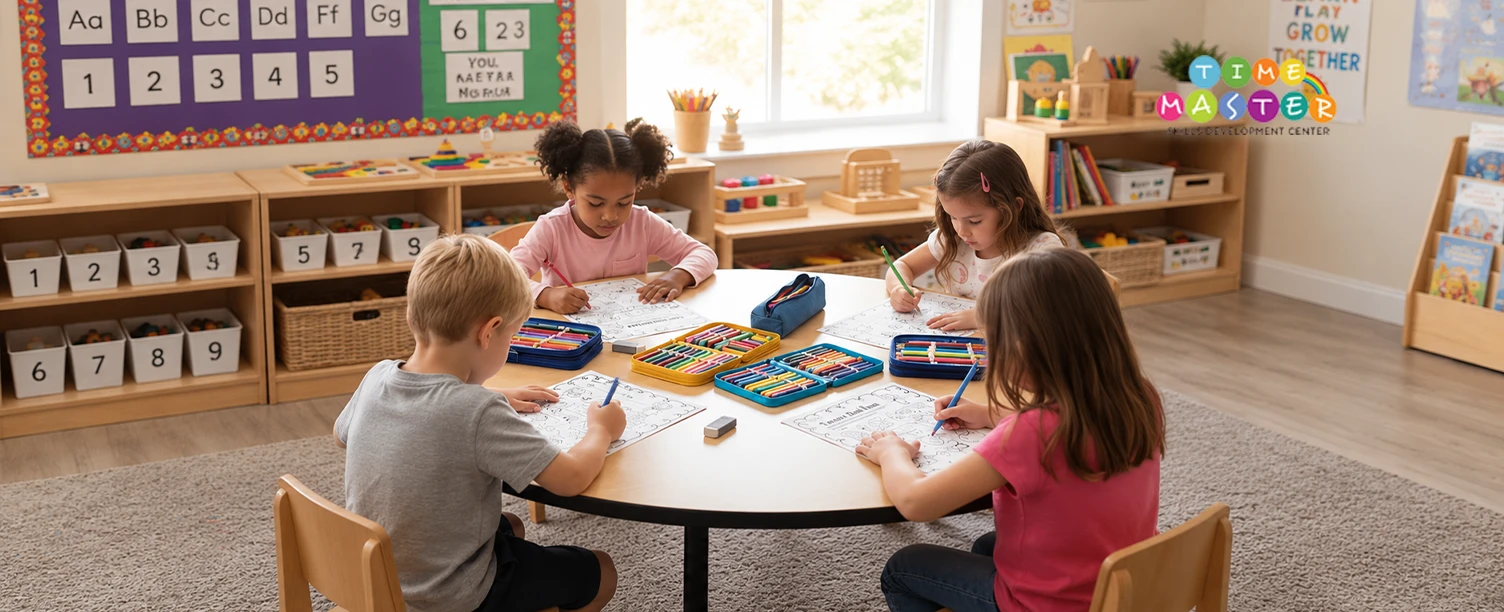
- Start with brightly coloured four lined pages because they first need to learn the alphabet's sizing and space them correctly.
- Never give the child plain white paper and regular ruled pages to write first.
- Giving them four lined pages helps them pick up cursive writing faster and easier.
2. Identify the problem and encourage it to solve it patiently
Usually, handwriting problems lie in four main areas:
- Letter Formation
- Sizing
- Space between words
- Line alignment
Identify the problem and help the child accordingly. Children often write illegibly to cover their mistakes too. This could be spelling or grammar. Low self-confidence also makes them write incomprehensibly. Please focus on the letters and concepts that they feel are challenging. Make sure the child controls the paper using two hands.
Finding out the underlying problem solves the problem halfway. Rather than asking the child to improve their handwriting in a vague and general manner, pinpointing the problem and helping them sort that out boosts confidence in a child. Try to do the same gently rather than as an accusation. Children need a positive and welcoming environment for any improvement in all fields. Make sure you help the child in an encouraging and positive environment and ambience rather than making them feel pressured and stressed.
The right chair with a back support, a convenient table along with the right stationery all matters when it comes to helping a child write neatly and comfortably. Posture and angle play an important role in a child's handwriting. Patience is the key to everything. Some children accomplish it faster, while some others move at a slow pace. Never lose hope and move forward patiently with your child's journey towards achieving a skill for a lifetime.
3. Enhance Fine Motor Skills at Home
Home plays a significant role in developing skills like handwriting. Children must be encouraged to develop fine motor skills at home by involving them in household activities and games that enhance their fine motor skills from a very young age. Age-appropriate activities, games, and puzzles must be incorporated into a child's routine. Parents should find time to sit with them and play along with them so that they develop these skills for a better future. This helps in the physical and mental requirements of a child.
Children should be encouraged to think out of the box. A foggy mirror, a patch of mud, a bowl of leftover sauce all make great surfaces for their writing practice. Whether the child is practising with his fingertips, a stick, or a pencil, inspiring creativity will ultimately benefit in good handwriting.
Children should never be left behind from doing age-appropriate household chores. The more time a child spends manipulating objects, the better he gets with fine motor skills. This, in turn, helps develop the physical requirements of writing, like holding the pencil correctly, balancing the surface of writing, maintaining the posture, enhancing dexterity, control, and coordination.
Preschool in Abu Dhabi offers many creative activities like cutting paper, colouring, using cutlery, playing blocks, stringing beads and clay modelling help strengthen a child's wrist and fingers. It also enhances coordination, focus and dexterity.
4. Keep on Practising with Patience
Each child is different. Some make it fast, and some are slow learners. No different is the case of handwriting too. Practising without losing hope is the critical factor that would lead to success. Never lose your cool even when the child makes mistakes or when he or she is lazy to write and practise. Handwriting is an art that can be acquired with much practice.
Try to make the activity more fun-filled. For example, offer the child special pencils that are attractive. Do not give children words to copy. Instead, try simple word puzzles, anagrams, hangman games, etc. Writing with a purpose makes it more worthwhile than a tedious, robotic activity. Many fun handwriting worksheets and handwriting based games are available on the net. You can download them and take printouts to help your child do their handwriting practice in a fun-filled manner.
Children have a low attention span and are easily distracted if they do not hook their interest in the first go. So it is challenging for a parent to find ways to keep them interested in a thing for long. A new stimulus has to be provided each time to maintain their interest. Here comes the help of handwriting classes, like handwriting courses for kids in Abu Dhabi.
Read Also: Fun Handwriting Activities for Kids
Conclusion
The journey towards achieving good handwriting can be tiresome for a parent and a child. However, the secret is perseverance with patience. With constant practice and determination, any child can achieve good handwriting. After all, handwriting still speaks volumes about a person, even in this digital world!
.webp)