Ask any parent what they want most for their child, and you'll rarely hear "straight A's" first. You'll hear things like "I want them to be confident," "I want them to know how to solve problems," or "I want them to be kind and capable when I'm not around to help."
That's skill development in a nutshell, and it's quietly become one of the biggest conversations in parenting circles across Abu Dhabi and Mussafah.
Here's the thing nobody tells new parents: your child doesn't need to be "gifted" to build these abilities. They need practice, patience, and the right environment. That's exactly what this article walks you through.
Quick Answer Box
| Question | Short Answer |
|---|---|
| What is skill development for kids? | The process of building abilities like communication, problem-solving, and social confidence through everyday practice and guided activities |
| At what age should it start? | From toddlerhood, most core skills form between ages 2 and 8 |
| Where can it happen? | At home, in play, and through structured skill development classes for kids |
| Why does it matter now? | Employers project that nearly 39% of core workplace skills will shift by 2030, with analytical thinking remaining the single most valued skill, meaning today's toddlers will need these foundations early |
1. What Does Skill Development Really Mean?
2. Why Does Skill Development Matter in Early Childhood?
2.1 The Numbers Parents Should Know
3. What Are the Essential Skills Every Child Actually Needs?
3.1 Problem-Solving Skills for Kids
3.2 Communication Skills for Kids
3.3 Critical Thinking for Kids
3.4 Social Skills
3.5 Creative Thinking
4. How Can Kids Learn These Skills at Home?
4.1 Turn Ordinary Moments Into Learning Moments
4.2 Play Is the Real Curriculum
5. What Skill Development Activities Work Best for Kids in Abu Dhabi?
6. Where Can Parents in Abu Dhabi and Mussafah Find the Right Support?
6.1 A Gentle Reminder for Parents
7. FAQs: What Is Skill Development, and How Can Your Kids Learn It?
What Does Skill Development Really Mean?
Skill development for kids simply means helping a child build practical, real-world abilities, not just academic knowledge.
Think of it as the difference between a child who can recite the alphabet and one who can use words to calmly explain they're upset instead of throwing a tantrum. Both matter, but only one prepares them for actual life.
Child development skills usually fall into a few buckets:
-
Cognitive skills: Thinking, reasoning, memory, focus
-
Communication skills: Public speaking, listening, expressing needs
-
Social skills: Sharing, empathy, teamwork, conflict resolution
-
Physical skills: Coordination, balance, fine motor skills
-
Emotional skills: Managing frustration, patience, self-regulation
None of these show up on a report card in preschool. But they shape everything that eventually does.
Why Does Skill Development Matter in Early Childhood?
Because the early years aren't just "cute"; they're construction years.
A child's brain forms the majority of its neural connections before age 6, which is exactly why skill development activities for kids work best when they start early rather than being crammed in later.
There's also a bigger picture worth knowing. Abu Dhabi and the wider UAE have been investing heavily in early learning infrastructure.
Dubai's early childhood centres alone grew enrolment by 8% in a single year, with 38 new centres opening to meet demand.
That's not a coincidence. Educators and policymakers across the region are recognising what child psychologists have said for decades: skills built early stick around longest.
The Numbers Parents Should Know
-
The UAE's pre-primary enrolment ratio is at 94%, up sharply from 81% a decade ago.
-
Learning poverty in children who are unable to read a simple text by age 10 has dropped from 33% to 26% as early learning support has improved (UNICEF).
-
Globally, analytical thinking, resilience, and creative thinking now top the list of skills employers value most, all of which start forming in early childhood, not adulthood.
None of this means you need to turn your living room into a classroom. It means the little things puzzles, pretend play, group games are doing more heavy lifting than they get credit for.
Helping children become confident and independent starts with developing essential life skills to equip your child for the real world, from communication and decision-making to problem-solving and self-management.
What are the Essential Skills Every Child Actually Needs?
Not every skill matters equally at every age. Here's what tends to make the biggest difference, especially for kids under 8:
-
Problem-Solving Skills For Kids
-
Communication skills for kids
-
Critical thinking for kids
-
Social skills
-
Creative thinking
1. Problem-solving skills for kids
Can they figure out a puzzle without immediately asking for help? Can they try a different approach when the first one fails? This is the seed of resilience.
2. Communication skills for kids
Can they say what they need instead of crying or grabbing? This alone prevents most toddler meltdowns.
Public speaking training can help children improve communication skills, build confidence, express ideas clearly, and become more comfortable speaking in front of others.
3. Critical thinking
Asking "why" isn't annoying; it's a skill. Encourage it instead of shutting it down.
Building confidence in children starts with giving them opportunities to express themselves, make choices, try new activities, and learn from mistakes in a supportive environment.
4. Social skills
Sharing, waiting their turn, and reading another child's mood come from practice, not instinct.
5. Creative thinking
Building something new out of blocks, inventing a story, and drawing something imaginary with creativity strengthens the same muscles used in later problem-solving.
You can foster creative thinking in your child by encouraging curiosity, giving them freedom to analyse ideas, and creating everyday opportunities to imagine, experiment, and solve problems.
How Can Kids Learn These Skills at Home?
You don't need a curriculum. You need consistency. Here's what actually works, without turning parenting into a full-time teaching job.
Turn Ordinary Moments Into Learning Moments
-
Let them help "cook" (stirring, pouring): builds coordination and following steps
-
Ask "what do you think happens next?" during stories: builds critical thinking
-
Give them small choices ("blue cup or red cup?"): builds decision-making
-
Let them struggle a little before jumping in: builds patience and grit
Play is the Real Curriculum
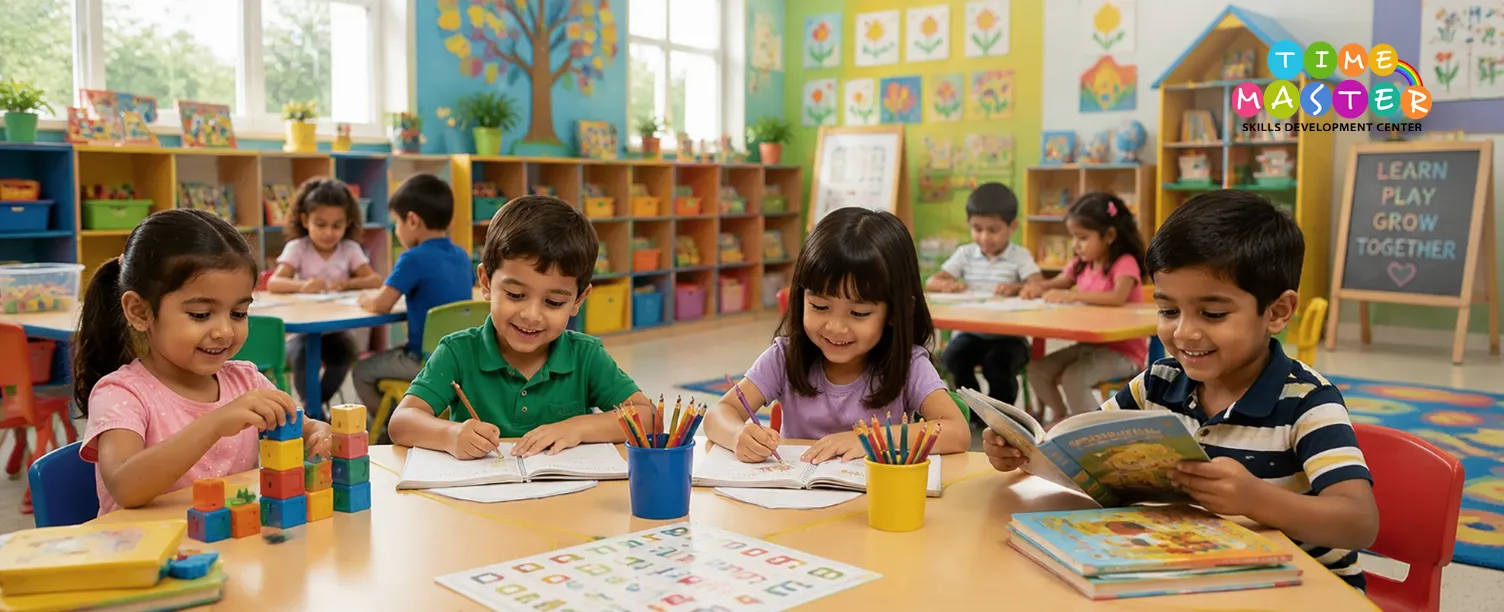
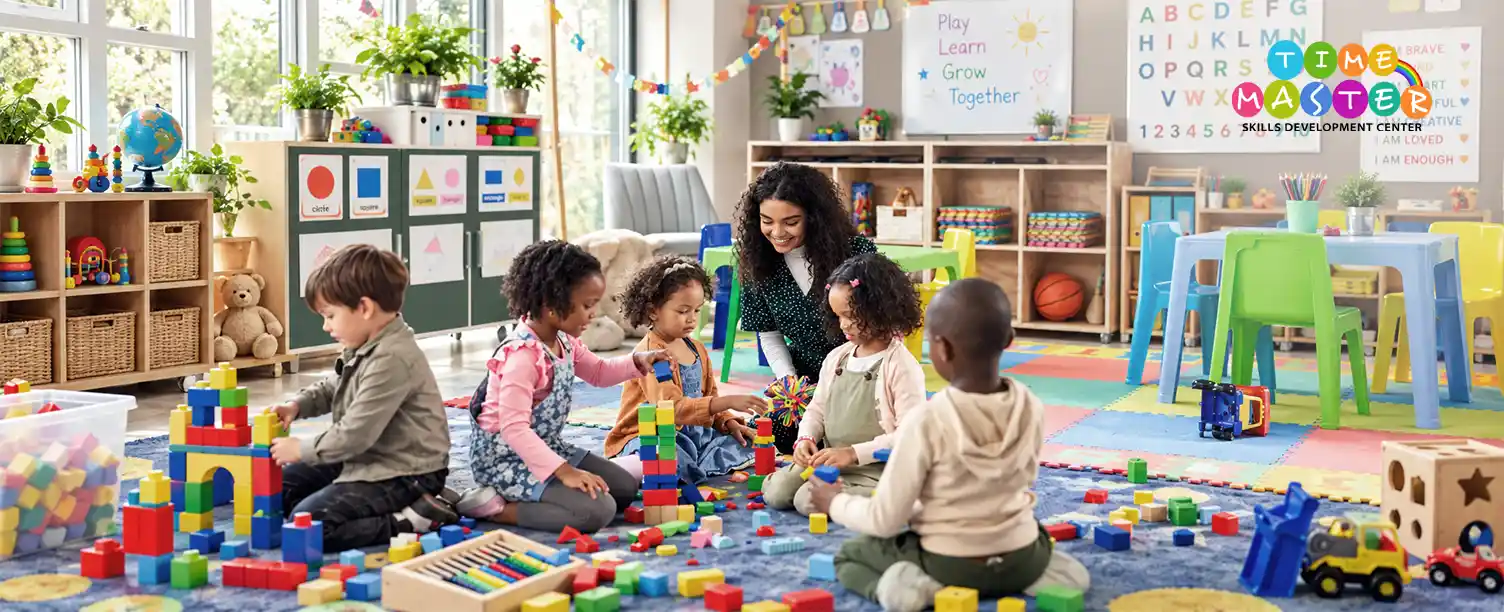
Kids' skill development activities don't need to look academic. Board games teach turn-taking. Building blocks teach spatial reasoning. Pretend play teaches empathy; a child "being the doctor" is quietly learning perspective-taking.
Regular movement and active play are essential for healthy growth, making physical activity for children an important part of early development.
What Skill Development Activities Work Best for Kids in Abu Dhabi?
Parents in Abu Dhabi and Mussafah have an advantage most cities don't: a genuine ecosystem of hands-on kids learning activities, from nature-based play to structured centres designed specifically around early skill-building.
A few ideas that work particularly well locally:
-
Outdoor and sensory play during cooler months; sand, water, and nature-based exploration build motor and sensory skills
-
Group-based classes that mix structured learning with free play, so kids build social skills alongside academic ones
-
Storytelling and role-play sessions, which strengthen both language and emotional understanding, helping to develop emotional intelligence and confidence.
-
Simple STEM activities like sorting, stacking, and basic building, early groundwork for problem-solving
Where Can Parents in Abu Dhabi and Mussafah Find the Right Support?
This is often where parents get stuck, not because they don't want to help, but because they're unsure whether home efforts are "enough."
They usually are, for a while. But structured environments add something home can't always replicate: peer interaction, consistent routine, and trained guidance.
If you're looking into skill development classes for kids in Abu Dhabi or a child development centre in Abu Dhabi, look for a few things:
-
A play-based (not purely academic) approach for younger kids
-
Small group sizes, so your child actually gets noticed
-
Teachers trained in early childhood development, not just general education
-
A calm, safe environment; skill-building doesn't happen under stress
For families around Mussafah specifically, proximity matters too; a nearby, familiar setting helps younger children settle in faster, which speeds up how quickly these skills actually take root.
A Gentle Reminder for Parents
If your child isn't "ahead," they're not behind either. Skill development isn't a race; it's a slow build, made of small repeated moments.
The child who struggles today to share a toy is the same child who, with enough patient practice, becomes the adult who can navigate a difficult conversation with ease.
That's really what all of this is for.
FAQ's
.webp)